
Amazon Flex Accidents in Kentucky
Amazon Flex drivers deliver in their own cars, so the first questions after an Amazon Flex accident are whether the app was on and whose insurance applies.
Amazon’s Flex locations list names three Kentucky markets: Lexington, London-Corbin, and Paducah. Flex drivers sign up for delivery shifts and use their own vehicles to deliver Amazon orders.
Amazon asks for a four-door midsize sedan or larger vehicle and personal auto insurance, so a Flex car looks like any other car on the road. Accidents with Amazon’s branded delivery vans follow different records and rules, covered on our delivery vehicle accident page.
When a Flex driver causes an accident, the injury case depends on what the Flex app showed at that moment, which policies were in force, and how much control Amazon had over the trip.
Flex App Delivery Blocks
Flex work is organized into blocks. Each block offer shows the date, delivery type, expected earnings, start time, and estimated duration, and Amazon.com blocks typically run 3 to 6 hours. The driver picks up at a delivery station or site, such as an Amazon fulfillment center or a Whole Foods Market, and taps “I’ve arrived” in the app on reaching the station.
The app supplies the route. Amazon Flex maps show known speed limits, road closures, and live traffic, and an instant offer displays the route and estimated mileage before the driver accepts it.
In a 2020 federal appeals decision, the court described Flex drivers as paid an hourly rate for their shifts but not paid for extra time when deliveries ran past the shift. The number of stops, the time left in the block, and the pace of the route are all part of the record after an accident.
Signs of an Amazon Flex Delivery
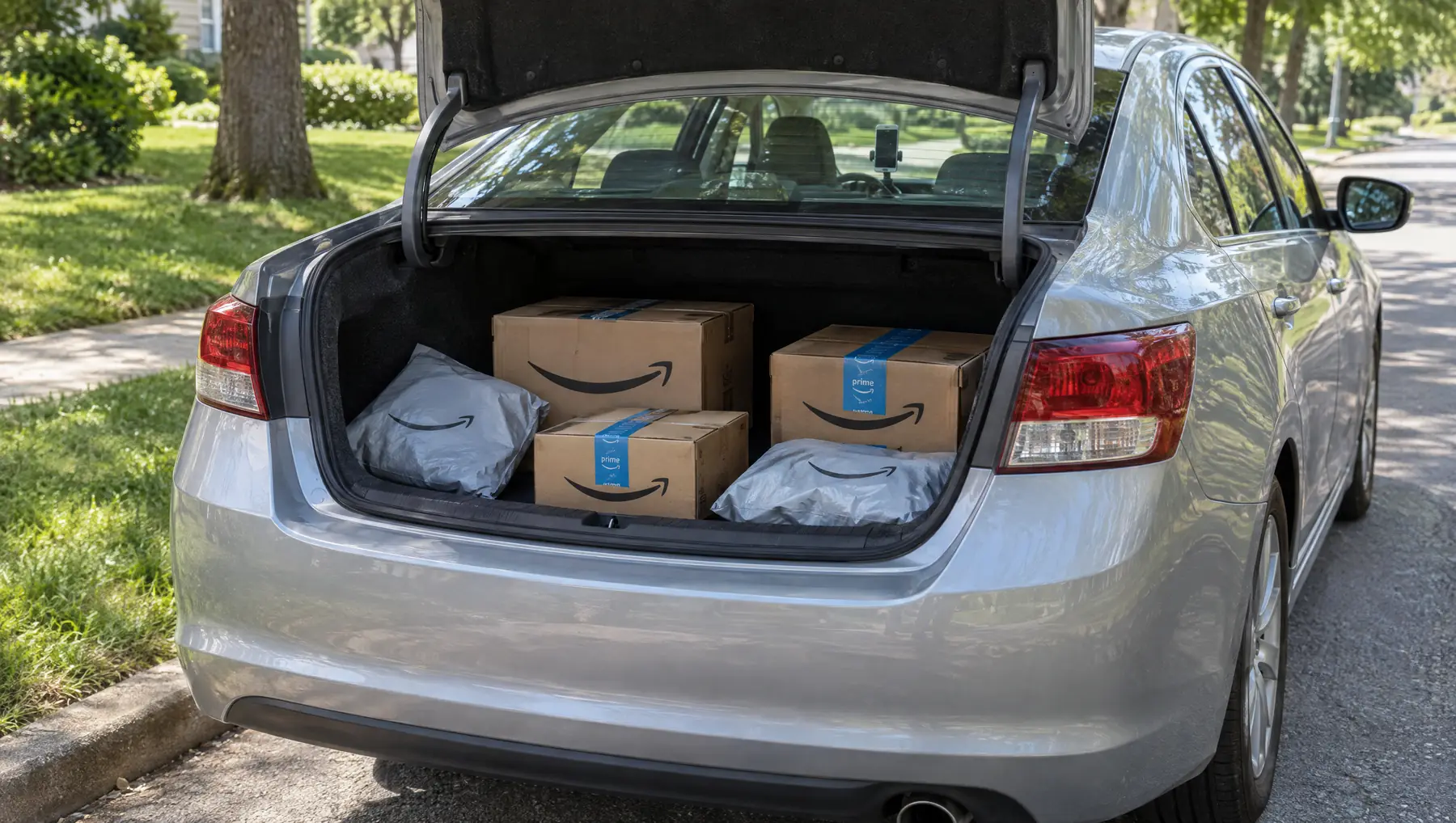
A Flex car carries no Amazon markings, so a police report can describe the accident as an ordinary two-car accident with no mention of Amazon. These details can show the car was out on a delivery:
- Amazon packages, mailers, or grocery bags on the seats or in the cargo area
- A reflective safety vest, which Amazon requires at its delivery stations and hands out free
- A phone on a dash mount showing a map or a delivery stop
- Repeated stops, turns, and backing at houses along one street
- A driver who puts packages out of sight before police arrive
Kentucky law puts the question to the driver directly. A delivery driver must carry proof of delivery insurance while using a personal vehicle with the app, and after an accident the driver or the company must say, on request, whether the driver was in a delivery available period or a delivery service period.
Early requests include 911 dispatch audio and records, video from doorbell and business cameras near the scene, and the driver’s phone records. Camera video goes first, because those systems can record over older footage.
Amazon Flex Insurance Coverage
Two sets of rules decide which policy pays: Kentucky’s delivery network company law and Amazon’s own commercial auto policy.
Kentucky Delivery Network Company Law
Kentucky regulates any company operating in the state that uses a digital network to connect customers who order goods with drivers using personal vehicles. The definitions carve out no retailer delivering its own customers’ orders. The law took effect January 1, 2025, and applies to motor vehicle policies issued or renewed on or after that date.
It splits the driver’s time into two periods. The delivery available period runs while the driver is logged on and eligible to receive delivery requests but is not delivering. The delivery service period begins when the driver starts driving to pick up goods, as documented by the company’s app, and ends at the last delivery or at a return to a location the company designates.
In both periods, the company must make sure primary liability coverage is in place that recognizes delivery work or does not exclude it, at no less than $50,000 per person, $100,000 per accident, and $25,000 for property damage, plus basic reparation benefits. If the driver’s own policy has lapsed or does not provide that coverage, the company’s insurance pays from the first dollar of the claim and must defend it, without waiting for another insurer to deny.
Amazon Commercial Auto Policy
Amazon says a Flex driver who keeps personal auto insurance is covered by the Amazon Commercial Auto Insurance Policy while actively driving and delivering, with $1,000,000 in auto liability coverage, plus uninsured and underinsured motorist coverage and contingent comprehensive and collision coverage. Its FAQ limits that policy to drivers who are actively delivering during a delivery block and denies a claim when anyone else was driving.
Amazon’s description is not the policy. The policy and its declarations page decide what it covers and when. Kentucky also requires the company to give each driver a written disclosure of the coverage types and limits it provides, and notice that the driver’s own policy might not cover delivery periods. That disclosure is a record to request.
Coverage by App Status
| App Status | Kentucky Minimum | Amazon’s Stated Coverage |
|---|---|---|
| App Off | The driver’s own policy: $25,000 per person, $50,000 per accident, and $25,000 for property damage under KRS 304.39-110 | None |
| Logged On, No Delivery | Primary coverage of $50,000 per person, $100,000 per accident, and $25,000 for property damage under KRS 365.532 | Not stated; Amazon describes coverage for active delivery during a block |
| Driving to Pickup Through Last Delivery | The same minimum under KRS 365.532 | $1,000,000 in auto liability while actively driving and delivering |
A driver on the road with the app switched to Online for instant offers, which start within 30 minutes, is operating a personal vehicle, logged on, and eligible for requests, the conditions that define the delivery available period. Disputes over coverage start in the space between the two columns.
Kentucky puts the burden of the timing records on the company. On request, the company must immediately provide the precise times the driver began and ended each period in the 24 hours before and after the accident. If the timing is disputed and the company does not have, did not keep, or fails to provide those times, its insurer takes primary liability for the claim.
Personal Auto Policy Exclusions
Personal auto policies can exclude delivery and business use, and Kentucky’s delivery law leaves those exclusions in force. A Flex driver’s own insurer can deny the claim once it learns the car was out on a delivery.
That denial does not end the claim. The first-dollar rule puts the delivery company’s insurance in the driver’s place for the statutory minimum. Above that, the injured person’s own underinsured motorist coverage pays damages beyond the other vehicle’s liability limits, up to the injured person’s underinsured limits. Kentucky insurers must make that coverage available on request.
Amazon’s Liability for Flex Drivers
Amazon treats Flex drivers as independent contractors, and its FAQ tells drivers they are free to decide how best to prepare for a block. Kentucky courts look at the actual relationship. In Sam Horne Motor & Implement Co. v. Gregg, 279 S.W.2d 755 (Ky. 1955), the state’s highest court, then the Court of Appeals, weighed the Restatement of Agency factors in a tort case over a company car. It called the right of control “probably the most significant consideration” and said close, actual control of the worker is not necessary.
Control Factors in Flex Records
| Factor | Flex Records |
|---|---|
| Control Over the Work | Block schedules, the route in the app, and delivery within a specified timeframe and in compliance with Amazon service standards |
| Tools and Equipment | The driver’s car and phone; Amazon’s app, maps, and commercial auto policy |
| Method of Payment | Earnings set by Amazon for each block and shown in the offer |
| Regular Business | Delivering products ordered through Amazon |
| Account Status | Amazon can disable a driver’s account, and Driver Support gives the reason |
Amazon also answers for its own decisions. Kentucky treats negligent hiring and retention of an employee as the employer’s own negligence: the employer knew or should have known the worker was unfit, and placing or keeping the worker on the job created an unreasonable risk of harm. Flex onboarding includes a background check that reviews motor vehicle records, so what Amazon saw in a driver’s record, and what it did about it, are questions for discovery.
Kentucky bars writing, sending, or reading text-based messages while the vehicle is moving, with an exception for GPS. The Flex app lets drivers call or text customers about a delivery, so app event logs can show whether the driver was messaging, confirming a drop, or reading delivery notes when the accident happened.
Amazon Flex Accident Records
| Source | Records |
|---|---|
| Flex App and Network | Start and end times of each delivery period, block assignment, route and stop list, package scans, the station check-in, customer calls and texts, and reports to Amazon’s emergency helpline |
| Amazon’s Insurer | Commercial auto policy, declarations page, and the written coverage disclosure given to the driver |
| Driver’s Phone | App data, location history, texts, and call logs |
| Driver’s Insurer | Personal auto policy, delivery or business-use exclusions, and any denial letter |
| Accident Scene | 911 dispatch audio and records, the police report, and doorbell and business camera video |
| Medical Providers | Emergency, hospital, and follow-up records, such as from UK HealthCare’s Albert B. Chandler Hospital or Baptist Health Lexington |
| Driver History | Background check, motor vehicle record, and account history with Amazon |
Video and phone data can be lost long before the deadline to sue, so preservation letters go to Amazon, the driver, and both insurers as early as possible.
Lawsuit Venue in Kentucky
An injury lawsuit can be filed in the county where the injury happened or where the defendant lives, and a tort claim against a corporation can be filed where the tort was committed. An accident on New Circle Road, Nicholasville Road, or a neighborhood street in Fayette County can be filed in Fayette Circuit Court against both the driver and Amazon.
Lexington Police Accident Reports
In Lexington, police collision reports can be requested online or at police headquarters at 150 E. Main Street, and only people involved in the accident can get one. A report on an open case becomes available five days after it is filed.
Kentucky Injury Case Rules
Federal trucking rules start at 10,001 pounds for a vehicle used across state lines. A sedan or SUV used for Flex sits below that line, so Kentucky law governs the case.
Basic reparation benefits pay up to $10,000 per person for economic loss from one accident. A claim for pain and suffering requires medical expense benefits over $1,000, or a broken bone, permanent injury, permanent disfigurement, loss of a body member, permanent loss of bodily function, or death. The threshold applies to a claim against a company responsible for the driver as well as the driver, unless the injured person filed a written rejection of those tort limits with the Department of Insurance before the accident.
A lawsuit must be filed within two years after the injury or death, or the last basic or added reparation payment, whichever is later. Under KRS 411.182, the jury assigns each party a percentage of fault, and each pays its share. A driver found 20 percent at fault still recovers 80 percent of the damages.
Amazon Delivery Cases at Hollan & Aguiar
Jon Hollan has handled Amazon delivery service partner cases and FedEx Ground contractor cases, and lawyers around the country consult him on them. Our trucking team focuses exclusively on trucking and commercial vehicle cases.
Frequently Asked Questions
Each answer applies Kentucky law and Amazon’s published Flex terms.
Does Amazon’s insurance cover a Flex driver at all times?
No. Amazon describes its commercial policy as covering drivers who are actively delivering during a block. Kentucky law separately requires primary coverage while the driver is logged on and available for requests, at lower minimums than Amazon’s $1,000,000 policy.
What should I do if an Amazon Flex driver hits my car and leaves?
Call 911, tell the dispatcher the car was carrying Amazon packages, and write down the plate number, the car, and anything you saw inside it. Ask nearby homes and businesses to save their camera video from that time before the systems record over it.
Can Amazon force my case into arbitration?
No. The Flex terms quoted in a 2020 federal appeals decision send disputes between the driver and Amazon to individual arbitration. An injured driver, passenger, or pedestrian who never accepted those terms is not a party to them, and the Supreme Court has said “a contract cannot bind a nonparty.”
Why did the Flex driver’s insurance company deny my claim?
Personal auto policies can exclude delivery and business use, and Kentucky’s delivery law keeps those exclusions in force. When the driver’s policy does not cover the accident, the delivery company’s insurance must provide the required coverage from the first dollar.
How long do I have to file a lawsuit after an Amazon Flex accident in Kentucky?
Two years after the injury or death, or the last no-fault payment, whichever is later. App records and camera video can be gone long before that, so preservation letters should go out early.